Recombinant Mouse Mast cell protease 4 (Mcpt4)
In Stock-
中文名稱:小鼠Mcpt4重組蛋白
-
品名簡稱:Recombinant Mouse Mcpt4 protein
-
貨號:CSB-YP325157MO
-
說明書:
-
規格:¥2208
-
圖片:
-
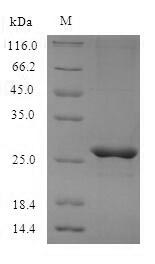 (Tris-Glycine gel) Discontinuous SDS-PAGE (reduced) with 5% enrichment gel and 15% separation gel.
-
-
其他:
產品詳情
-
純度:Greater than 90% as determined by SDS-PAGE.
-
基因名:Mcpt4
-
Uniprot No.:
-
別名:Mast cell protease 4; Mcp 4; Mcpt4; MCPT4_MOUSE; MMCP 4; MMCP 4A; MMCP 4B; MMCP-4; MMCP4; MMCP4A; MMCP4B; MSMCP; Myonase; Serosal mast cell protease
-
種屬:Mus musculus (Mouse)
-
蛋白長度:Full Length of Mature Protein
-
來源:Yeast
-
分子量:27.1kDa
-
表達區域:21-246aa
-
氨基酸序列IIGGVESRPHSRPYMAHLEITTERGFTATCGGFLITRQFVMTAAHCSGREITVTLGAHDVSKTESTQQKIKVEKQIVHPKYNFYSNLHDIMLLKLQKKAKETPSVNVIPLPRPSDFIKPGKMCRAAGWGRTGVTEPTSDTLREVKLRIMDKEACKNYWHYDYNLQVCVGSPRKKRSAYKGDSGGPLLCAGVAHGIVSYGRGDAKPPAVFTRISSYVPWINRVIKGE
Note: The complete sequence may include tag sequence, target protein sequence, linker sequence and extra sequence that is translated with the protein sequence for the purpose(s) of secretion, stability, solubility, etc.
If the exact amino acid sequence of this recombinant protein is critical to your application, please explicitly request the full and complete sequence of this protein before ordering. -
蛋白標簽:N-terminal 6xHis-tagged
-
產品提供形式:Liquid or Lyophilized powder
Note: We will preferentially ship the format that we have in stock, however, if you have any special requirement for the format, please remark your requirement when placing the order, we will prepare according to your demand. -
緩沖液:If the delivery form is liquid, the default storage buffer is Tris/PBS-based buffer, 5%-50% glycerol.
Note: If you have any special requirement for the glycerol content, please remark when you place the order.
If the delivery form is lyophilized powder, the buffer before lyophilization is Tris/PBS-based buffer, 6% Trehalose. -
儲存條件:Store at -20°C/-80°C upon receipt, aliquoting is necessary for mutiple use. Avoid repeated freeze-thaw cycles.
-
保質期:The shelf life is related to many factors, storage state, buffer ingredients, storage temperature and the stability of the protein itself.
Generally, the shelf life of liquid form is 6 months at -20°C/-80°C. The shelf life of lyophilized form is 12 months at -20°C/-80°C. -
貨期:3-7 business days
-
注意事項:Repeated freezing and thawing is not recommended. Store working aliquots at 4°C for up to one week.
-
產品描述:Recombinant Mouse Mast cell protease 4(Mcpt4) is a partial length protein expressed with N-terminal 6xHis-tagged in the yeast. Its expression region corresponds to 21-246aa of mouse Mcpt4 protein. Its purity was determined by SDS-PAGE and reached up to 90% and presented a molecular mass band of 27.1 kDa on the gel. This recombinant Mcpt4 protein may be used to synthesize antibodies against Mcpt4.
Mcpt4 has chymotrypsin-like activity. This protein can hydrolyze the amide bonds of synthetic substrates having Tyr and Phe residues at the P1 position. It preferentially hydrolyzes the 'Tyr-4-|-Ile-5' bond of angiotensin I and the 'Phe-20-|-Ala-21' bond of amyloid beta-protein, and is less active towards the 'Phe-8-|-His-9' bond of angiotensin I and the 'Phe-4-|-Ala-5' and 'Tyr-10-|-Glu-11' bonds of amyloid beta-protein. Study supports a role for mMCP-4 in the early inflammatory phases of the disease in a mouse model of MS. -
Datasheet & COA:Please contact us to get it.
產品評價

相關產品
問答及客戶評論
I requested for the following information. Kindly provide assistance CSB-YP325157MO, Recombinant Mouse Mast cell protease 4(Mcpt4)
1.Availability of 200 ug size and delivery lead time
2.Is the product biologically active?
3.Price of 200 ug
Name: Recombinant Mouse Mast cell protease 4(Mcpt4)
Expression Region: 21-246aa; Full Length of Mature Protein
Tag Info: N-terminal 6xHis-tagged
Expression Sequence:
IIGGVESRPHSRPYMAHLEITTERGFTATCGGFLITRQFVMTAAHCSGREITVTLGAHDVSKTESTQQKIKVEKQIVHPKYNFYSNLHDIMLLKLQKKAKETPSVNVIPLPRPSDFIKPGKMCRAAGWGRTGVTEPTSDTLREVKLRIMDKEACKNYWHYDYNLQVCVGSPRKKRSAYKGDSGGPLLCAGVAHGIVSYGRGDAKPPAVFTRISSYVPWINRVIKGE
Product Type: Developed Recombinant Protein
Biological Activity: We haven't tested its activity yet so we can't 100% guarantee that it is active. The protein we provide is full length of mature protein purified under mild conditions, which should have activity
in theory.
Packing Size: If you want to purchase 200ug, we suggest to deliver Lyophilized Powder packed into 100ug*2 vials.
靶點詳情
-
功能:Has chymotrypsin-like activity. Hydrolyzes the amide bonds of synthetic substrates having Tyr and Phe residues at the P1 position. Preferentially hydrolyzes the 'Tyr-4-|-Ile-5' bond of angiotensin I and the 'Phe-20-|-Ala-21' bond of amyloid beta-protein, and is less active towards the 'Phe-8-|-His-9' bond of angiotensin I and the 'Phe-4-|-Ala-5' and 'Tyr-10-|-Glu-11' bonds of amyloid beta-protein. Involved in thrombin regulation and fibronectin processing.
-
基因功能參考文獻:
- deletion of the gene encoding MMCP-4 (Mcpt4), markedly reduced late, but not early, infarct size by suppressing IGF-1 degradation and, consequently, diminished cardiac dysfunction and adverse structural remodeling PMID: 27274047
- study supports a role for mMCP-4 in the early inflammatory phases of the disease in a mouse model of MS. PMID: 27610007
- These results suggest that the inhibition of mMCP-4 reduces lesion spreading in the earlier phases of atherosclerosis development and can help stabilise the more advanced plaque PMID: 26976326
- Results suggest that mouse mast cell proteases 4, 5, and 6 are mediators of the critical role mast cells play in microdeformational wound therapy in the proliferative phase of healing. PMID: 24814421
- Data indicate that a second-degree burn injury can initiate an immediate novel zonal degranulation of mast cell throughout all skin layers and a disruption of the epidermal tight junctions dependent on the nonredundant presence of mMCP4 and mMCP5. PMID: 24523504
- these results support the conclusion that mast cells can contribute to the initial lung injury induced by bleomycin through release of the MCPT4 chymase. PMID: 24453258
- knock-outs demonstrate elevated airway reactivity and eosinophilia, and higher levels of serum immunoglobulin E PMID: 23235745
- Mast cell chymase degrades the alarmins heat shock protein 70, biglycan, HMGB1, and interleukin-33 (IL-33) and limits danger-induced inflammation. PMID: 24257755
- Mast cell released mMCP4 has anti-fibrotic potential in acutely induced obstructive nephropathy. PMID: 23515052
- Data from Mcp-4 (mast cell protease 4) knockout mice suggest Mcp-4 plays a pivotal role in the dynamic (in vivo and in vitro) conversion of systemic Big-endothelin-1 to endothelin-1 (1-31). PMID: 23596057
- MCs exert protective functions after trauma, at least in part via mMCP-4, by suppressing exacerbated inflammation via their proteases. PMID: 23193170
- The effects of interactions between mMCP-4 and TNF in vivo by analyzing the features of a classic model of polymicrobial sepsis, were assessed. PMID: 22901752
- mMCP-4 plays two different roles in the pathogenesis of experimental BP, by both activating MMP-9 and by cleaving BP180, leading to injury of the hemidesmosomes and extracellular matrix of the basement membrane zone. PMID: 21880713
- mMCP-4-deficient mice but not to mMCP-5-deficient mice revealing nonredundant actions for these two MC proteases in a model of innate inflammatory injury with remodeling. PMID: 21076070
- MCP-4 contributes locally to the aggravation of glomerulonephritis by mediating a variety of proinflammatory effects. PMID: 20530261
- mice deficient in mast cells (Kit(W-sh/W-sh) [Wsh]) or mast cell chymase (Mcpt4(-/-)) have significantly decreased basal small intestinal permeability compared with wild-type (WT) mice PMID: 20018751
- localization in skeletal muscle myofibrils PMID: 12204111
- Data describe a mouse strain with a targeted deletion in the gene for mast cell protease 4 (mMCP-4), in terms of tissue localization and functional properties. PMID: 12900518
- mast cell mMCP-4, -5, and -6 (chymase and tryptase) participate in the acute inflammation and remodeling process of viral myocarditis. PMID: 14578624
- mast cell chymase and CPA have key roles in both the generation and degradation of Ang II PMID: 15173164
- key role for mast cell chymase in the regulation of pro-MMP-2 and -9 activities (mast cell chymase AND pro-mmp-2 AND -9) PMID: 15615702
- Mast cell protease 4 reduces the antibody response and the severity of disease in autoimmune arthritis. PMID: 19010978
- abdominal aortic aneurysm lesions in Mcpt4(-/-) mice had fewer inflammatory cells and less apoptosis, angiogenesis, and elastin fragmentation than those of WT mice PMID: 19720934
- chymase (MCP-4) present in the upper airways protects against allergic airway responses, possibly by regulating smooth muscle cells. PMID: 19841188
顯示更多
收起更多
-
蛋白家族:Peptidase S1 family, Granzyme subfamily
-
組織特異性:Submucosal mast cells. In femoral muscle, detected in myocytes but not in mast cells.
-
數據庫鏈接:
Most popular with customers
-
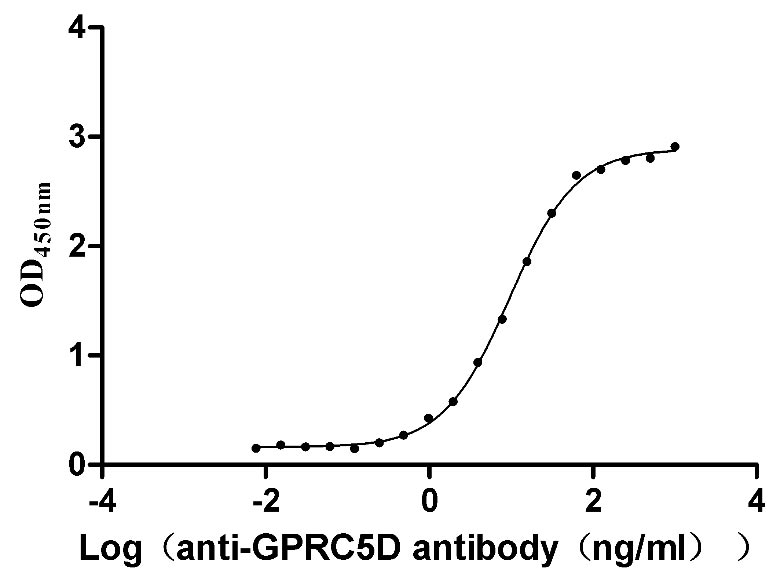
Recombinant Human G-protein coupled receptor family C group 5 member D (GPRC5D)-VLPs (Active)
Express system: Mammalian cell
Species: Homo sapiens (Human)
-
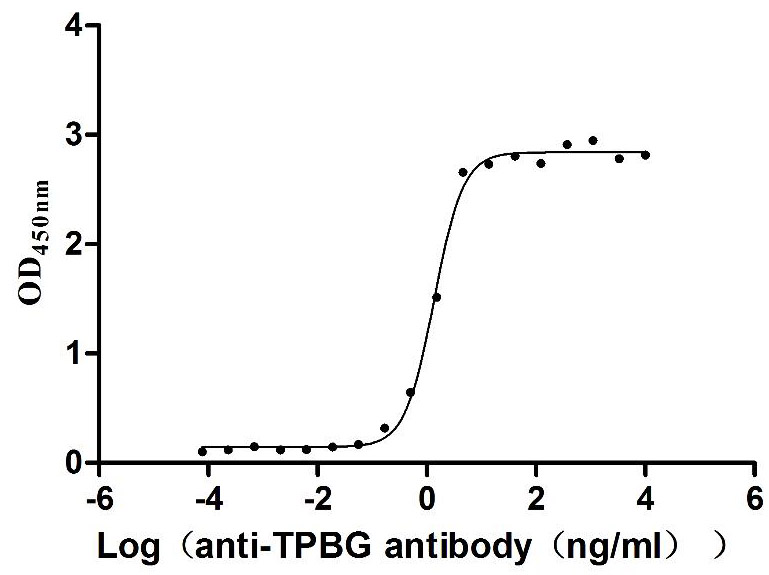
Recombinant Human Trophoblast glycoprotein (TPBG), partial (Active)
Express system: Mammalian cell
Species: Homo sapiens (Human)
-
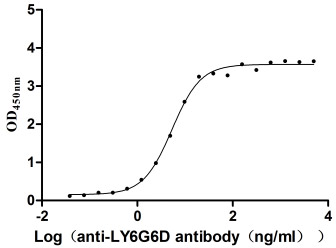
Recombinant Macaca fascicularis lymphocyte antigen 6 family member G6D (LY6G6D) (Active)
Express system: Yeast
Species: Macaca fascicularis (Crab-eating macaque) (Cynomolgus monkey)
-
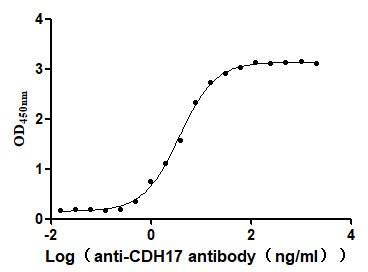
Recombinant Human Cadherin-17 (CDH17), partial (Active)
Express system: Mammalian cell
Species: Homo sapiens (Human)