USP4 Antibody
-
中文名稱:USP4兔多克隆抗體
-
貨號:CSB-PA614393LA01HU
-
規格:¥440
-
圖片:
-
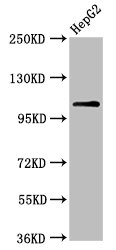 Western Blot
Positive WB detected in: HepG2 whole cell lysate
All lanes: USP4 antibody at 6.3µg/ml
Secondary
Goat polyclonal to rabbit IgG at 1/50000 dilution
Predicted band size: 109, 104, 36 kDa
Observed band size: 109 kDa -
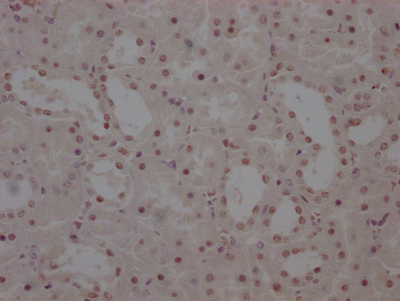
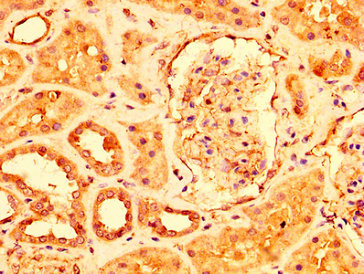 IHC image of CSB-PA614393LA01HU diluted at 1:500 and staining in paraffin-embedded human kidney tissue performed on a Leica BondTM system. After dewaxing and hydration, antigen retrieval was mediated by high pressure in a citrate buffer (pH 6.0). Section was blocked with 10% normal goat serum 30min at RT. Then primary antibody (1% BSA) was incubated at 4°C overnight. The primary is detected by a biotinylated secondary antibody and visualized using an HRP conjugated SP system.
 -
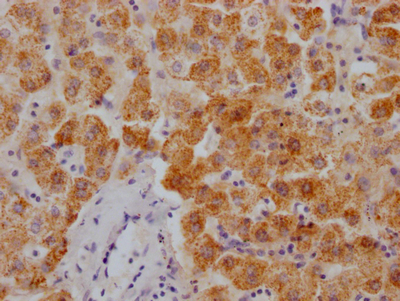
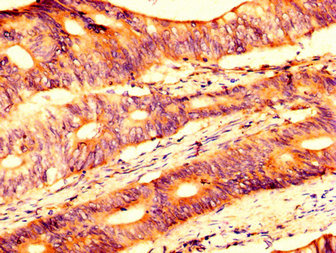 IHC image of CSB-PA614393LA01HU diluted at 1:500 and staining in paraffin-embedded human colon cancer performed on a Leica BondTM system. After dewaxing and hydration, antigen retrieval was mediated by high pressure in a citrate buffer (pH 6.0). Section was blocked with 10% normal goat serum 30min at RT. Then primary antibody (1% BSA) was incubated at 4°C overnight. The primary is detected by a biotinylated secondary antibody and visualized using an HRP conjugated SP system.
 -
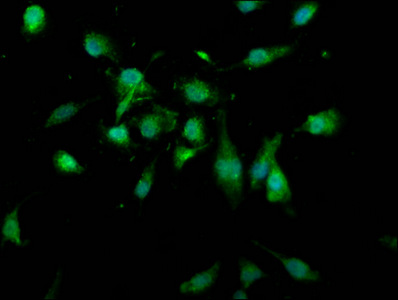 Immunofluorescence staining of U251 cells with CSB-PA614393LA01HU at 1:166, counter-stained with DAPI. The cells were fixed in 4% formaldehyde, permeabilized using 0.2% Triton X-100 and blocked in 10% normal Goat Serum. The cells were then incubated with the antibody overnight at 4°C. The secondary antibody was Alexa Fluor 488-congugated AffiniPure Goat Anti-Rabbit IgG(H+L).
-
-
其他:
產品詳情
-
產品名稱:Rabbit anti-Homo sapiens (Human) USP4 Polyclonal antibody
-
Uniprot No.:
-
基因名:
-
別名:Deubiquitinating enzyme 4 antibody; MGC149848 antibody; MGC149849 antibody; Proto oncogene antibody; Protooncogene antibody; Ubiquitin carboxyl terminal hydrolase 4 antibody; Ubiquitin carboxyl-terminal hydrolase 4 antibody; Ubiquitin specific peptidase 4 (proto oncogene) antibody; Ubiquitin specific peptidase 4 (protooncogene) antibody; Ubiquitin specific peptidase 4 antibody; Ubiquitin specific processing protease 4 antibody; Ubiquitin specific protease 4 (proto oncogene) antibody; Ubiquitin specific protease 4 (protooncogene) antibody; Ubiquitin specific protease 4 antibody; Ubiquitin specific protease proto oncogene antibody; Ubiquitin specific protease protooncogene antibody; Ubiquitin thioesterase 4 antibody; Ubiquitin thiolesterase 4 antibody; Ubiquitin-specific-processing protease 4 antibody; Ubiquitous nuclear protein homolog antibody; UBP4_HUMAN antibody; UNP antibody; UNPH antibody; USP 4 antibody; USP4 antibody
-
宿主:Rabbit
-
反應種屬:Human
-
免疫原:Recombinant Human Ubiquitin carboxyl-terminal hydrolase 4 protein (632-810AA)
-
免疫原種屬:Homo sapiens (Human)
-
標記方式:Non-conjugated
本頁面中的產品,USP4 Antibody (CSB-PA614393LA01HU),的標記方式是Non-conjugated。對于USP4 Antibody,我們還提供其他標記。見下表:
-
克隆類型:Polyclonal
-
抗體亞型:IgG
-
純化方式:>95%, Protein G purified
-
濃度:It differs from different batches. Please contact us to confirm it.
-
保存緩沖液:Preservative: 0.03% Proclin 300
Constituents: 50% Glycerol, 0.01M PBS, pH 7.4 -
產品提供形式:Liquid
-
應用范圍:ELISA, WB, IHC, IF
-
推薦稀釋比:
Application Recommended Dilution WB 1:500-1:5000 IHC 1:500-1:1000 IF 1:50-1:200 -
Protocols:
-
儲存條件:Upon receipt, store at -20°C or -80°C. Avoid repeated freeze.
-
貨期:Basically, we can dispatch the products out in 1-3 working days after receiving your orders. Delivery time maybe differs from different purchasing way or location, please kindly consult your local distributors for specific delivery time.
-
用途:For Research Use Only. Not for use in diagnostic or therapeutic procedures.
產品評價

相關產品
靶點詳情
-
功能:Deubiquitinating enzyme that removes conjugated ubiquitin from target proteins. Deubiquitinates PDPK1. Deubiquitinates TRIM21. Deubiquitinates receptor ADORA2A which increases the amount of functional receptor at the cell surface. May regulate mRNA splicing through deubiquitination of the U4 spliceosomal protein PRPF3. This may prevent its recognition by the U5 component PRPF8 thereby destabilizing interactions within the U4/U6.U5 snRNP. May also play a role in the regulation of quality control in the ER.
-
基因功能參考文獻:
- Data showed significantly increased expression of USP4 in cancer tissues compared to that in para-carcinoma tissues. PMID: 28946564
- The data indicate that USP4 interacts with and deubiquitinates IRF4, and also stabilizes IRF4 protein and promotes IRF4 function to facilitate IL-4 expression in Th2 cells, which may be related to the pathological process of rheumatic heart disease. PMID: 28791349
- These results identify USP4 as a novel regulator of Dvl in Wnt/beta-catenin signal and show its involvement in Wnt3a-induced osteoblast differentiation PMID: 27128386
- Data suggest that ubiquitin specific protease 4 (USP4) interacts with interferon regulatory factor 8 (IRF8) and, by its Lys48-specific deubiquitinase/endopeptidase activity, stabilizes IRF8 protein levels in regulatory T-lymphocytes; USP4 and IRF8 are also expressed in helper T-lymphocytes. PMID: 28477415
- USP4 inhibits p53 and NF-kappaB through deubiquitinating and stabilizing HDAC2 PMID: 26411366
- ubiquitin-specific protease 4 (USP4) is a binding partner of RNPS1. PMID: 27990632
- Data indicate that programmed cell death 4 (PDCD4) was identified to be a target of ubiquitin-specific protease 4 (USP4), which plays a role as a tumor suppressor. PMID: 27430936
- Ubiquitin-specific protease 4 (USP4), recently identified as a beta-catenin-specific deubiquitinylating enzyme, was highly expressed in PC14PE6/LvBr4 cells and involved in the increased stability of beta-catenin protein. PMID: 26883469
- USP4 knockdown in HCT116, a colon cancer cell line, reduced invasion and migration activity. PMID: 26189775
- USP4 cooperates with CtIP in DNA double-strand break end resection. PMID: 26387952
- Results demonstrate that aberrant expression of USP4 contributes to the development and progression of colorectal cancer and reveal a critical mechanism underlying USP4-mediated oncogenic activity. PMID: 26669864
- findings thus identify USP4 as a novel DNA repair regulator and invoke a model in which ubiquitin adducts regulate USP enzyme interactions and functions. PMID: 26455393
- USP4 and IL-17 mRNA, but not RORgammat mRNA, were significantly elevated in CD4(+) T cells from patients with rheumatic heart disease PMID: 25821221
- USP4 overexpression is associated with hepatocellular carcinoma. PMID: 24798342
- Authors identified USP4 as a new positive regulator for RIG-I that acts through deubiquitinating K48-linked ubiquitin chains and stabilizing RIG-I. PMID: 23388719
- Data suggest that USP4 down-regulates RIP1 (receptor-interacting serine-threonine kinase 1)-mediated TNFalpha (tumor necrosis factor-alpha) activation and promotes TNFalpha-induced apoptosis via deubiquitination of RIP1 in head/neck carcinoma. PMID: 23313255
- the interaction with USP4 may regulate the structure and function of the proteasome or the turnover of specific proteasomal substrates. PMID: 23022198
- USP4 plays an essential role in negative regulation of the TLR/IL-1R signaling-mediated innate immune response PMID: 22262844
- Results uncover USP4 as an important determinant for crosstalk between TGF-beta/TGF-beta type I receptor and AKT signalling pathways. PMID: 22706160
- identify the Ubiquitin-Specific Protease 4 (USP4) as an enzyme that removes ubiquitin from PDK1 in vivo and in vitro and co-localizes with PDK1 at the plasma membrane when the two proteins are overexpressed, indicating direct deubiquitination PMID: 22347420
- Results demonstrate that USP4 serves as a critical control to downregulate TNFalpha-induced NF-kappaB activation through deubiquitinating TAK1. PMID: 21331078
- USP4 deubiquitinates both TRAF2 and TRAF6 in vivo and in vitro in a deubiquitinase activity-dependent manner and inhibits TNFalpha-induced cancer cell migration. PMID: 22029577
- Studies indicate that the cylindromatosis/turban tumor syndrome gene (CYLD) ranked highest, followed by acylaminoacyl-peptidase (APEH), dystroglycan (DAG1), macrophage-stimulating protein (MST1) and ubiquitin-specific peptidase 4 (USP4). PMID: 21931648
- modulation of USP4 expression may provide a new means to interfere with canonical Wnt signalling in a variety of physiological and pathological conditions PMID: 20141612
- These results suggest that UnpEL colocalizes with the unubiquitinated form of Ro52 to the cytoplasmic rod-like structures. PMID: 16316627
- Ro52 and UnpEL transregulate each other by ubiquitination and deubiquitination PMID: 16472766
顯示更多
收起更多
-
亞細胞定位:Cytoplasm. Nucleus.
-
蛋白家族:Peptidase C19 family, USP4 subfamily
-
組織特異性:Overexpressed in small cell tumors and adenocarcinomas of the lung compared to wild-type lung (at protein level). Expressed in the hippocampal neurons.
-
數據庫鏈接:
Most popular with customers
-
-
YWHAB Recombinant Monoclonal Antibody
Applications: ELISA, WB, IHC, IF, FC
Species Reactivity: Human, Mouse, Rat
-
Phospho-YAP1 (S127) Recombinant Monoclonal Antibody
Applications: ELISA, WB, IHC
Species Reactivity: Human
-
-
-
-
-